 Add to Chrome
 Add to Firefox
 Add to Edge
Resolving Action Bottleneck: Agentic Reinforcement Learning Informed by Token-Level Energy
May 14, 2026
Agentic reinforcement learning trains large language models using multi-turn trajectories that interleave long reasoning traces with short environment-facing actions. Common policy-gradient methods, such as PPO and GRPO, treat each token in a trajectory equally, leading to uniform credit assignment. In this paper, we critically demonstrate that such uniform credit assignment largely misallocates token-level training signals. From an energy-based modeling perspective, we show that token-level training signals, quantified by their correlations with reward variance of different rollouts sampled from a given prompt, concentrate sharply on action tokens rather than reasoning tokens, even though action tokens account for only a small fraction of the trajectory. We refer to this phenomenon as the Action Bottleneck. Motivated by this observation, we propose an embarrassingly simple token reweighting approach, ActFocus, that downweights gradients on reasoning tokens, along with an additional energy-based redistribution mechanism that further increases the weights on action tokens with higher uncertainty. Across four environments and different model sizes, ActFocus consistently outperforms PPO and GRPO, yielding final-step gains of up to 65.2 and 63.7 percentage points, respectively, without any additional runtime or memory cost.

When Users Change Their Mind: Evaluating Interruptible Agents in Long-Horizon Web Navigation
Apr 01, 2026As LLM agents transition from short, static problem solving to executing complex, long-horizon tasks in dynamic environments, the ability to handle user interruptions, such as adding requirement or revising goals, during mid-task execution is becoming a core requirement for realistic deployment. However, existing benchmarks largely assume uninterrupted agent behavior or study interruptions only in short, unconstrained language tasks. In this paper, we present the first systematic study of interruptible agents in long-horizon, environmentally grounded web navigation tasks, where actions induce persistent state changes. We formalize three realistic interruption types, including addition, revision, and retraction, and introduce InterruptBench, a benchmark derived from WebArena-Lite that synthesizes high-quality interruption scenarios under strict semantic constraints. Using a unified interruption simulation framework, we evaluate six strong LLM backbones across single- and multi-turn interruption settings, analyzing both their effectiveness in adapting to updated intents and their efficiency in recovering from mid-task changes. Our results show that handling user interruptions effectively and efficiently during long-horizon agentic tasks remains challenging for powerful large-scale LLMs. Code and dataset are available at https://github.com/HenryPengZou/InterruptBench.
Actor-Curator: Co-adaptive Curriculum Learning via Policy-Improvement Bandits for RL Post-Training
Feb 24, 2026Post-training large foundation models with reinforcement learning typically relies on massive and heterogeneous datasets, making effective curriculum learning both critical and challenging. In this work, we propose ACTOR-CURATOR, a scalable and fully automated curriculum learning framework for reinforcement learning post-training of large language models (LLMs). ACTOR-CURATOR learns a neural curator that dynamically selects training problems from large problem banks by directly optimizing for expected policy performance improvement. We formulate problem selection as a non-stationary stochastic bandit problem, derive a principled loss function based on online stochastic mirror descent, and establish regret guarantees under partial feedback. Empirically, ACTOR-CURATOR consistently outperforms uniform sampling and strong curriculum baselines across a wide range of challenging reasoning benchmarks, demonstrating improved training stability and efficiency. Notably, it achieves relative gains of 28.6% on AIME2024 and 30.5% on ARC-1D over the strongest baseline and up to 80% speedup. These results suggest that ACTOR-CURATOR is a powerful and practical approach for scalable LLM post-training.
Semi-Supervised In-Context Learning: A Baseline Study
Mar 04, 2025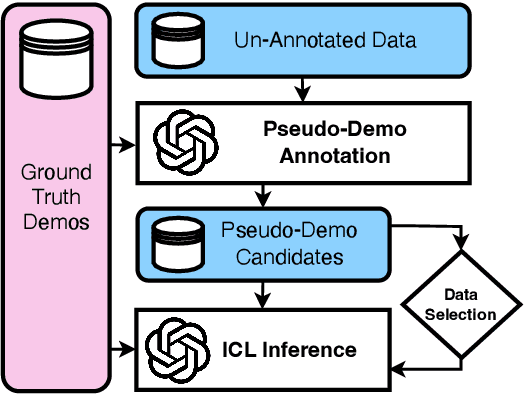
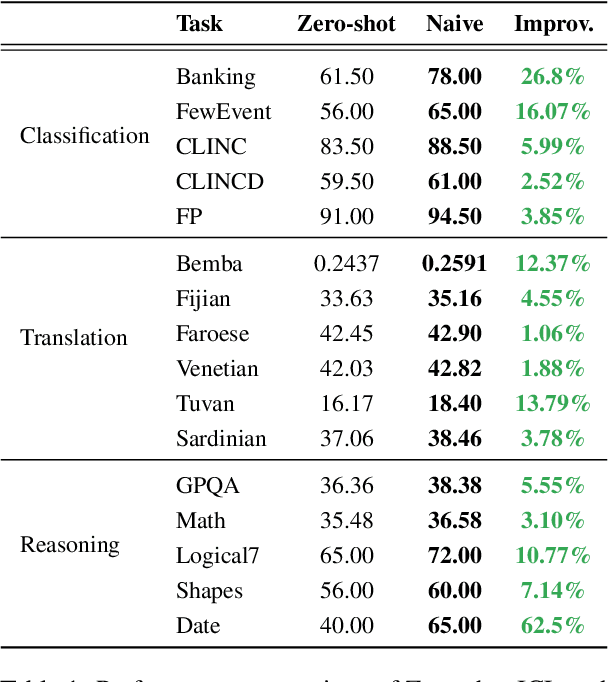

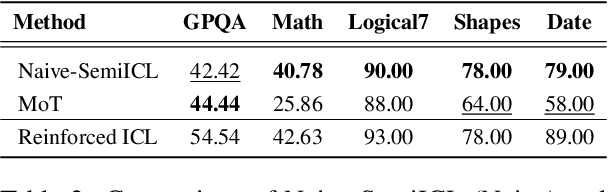
Most existing work in data selection for In-Context Learning (ICL) has focused on constructing demonstrations from ground truth annotations, with limited attention given to selecting reliable self-generated annotations. In this work, we propose a three-step semi-supervised ICL framework: annotation generation, demonstration selection, and semi-supervised inference. Our baseline, Naive-SemiICL, which prompts select high-confidence self-generated demonstrations for ICL prompting, outperforms a 16-shot baseline by an average of 9.94% across 16 datasets. We further introduce IterPSD, an annotation approach that refines pseudo-demonstrations iteratively, achieving up to 6.8% additional gains in classification tasks. Lastly, we reveal a scaling law for semi-supervised ICL, where models achieve optimal performance with over 1,000 demonstrations.
TestNUC: Enhancing Test-Time Computing Approaches through Neighboring Unlabeled Data Consistency
Feb 26, 2025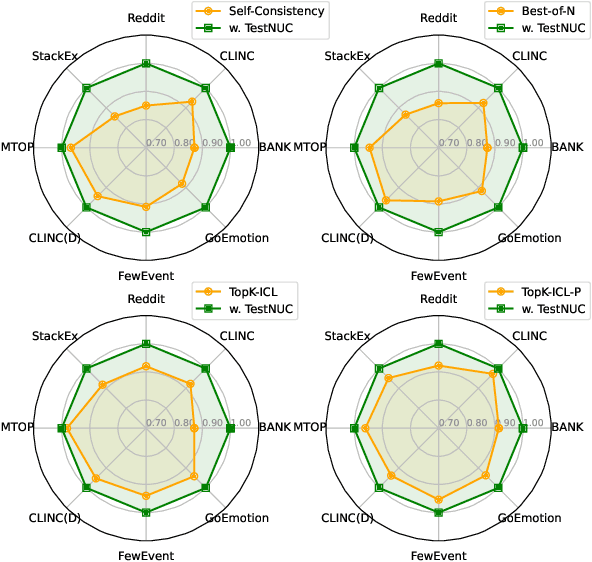
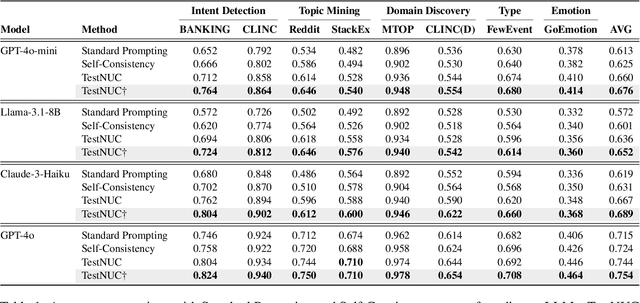
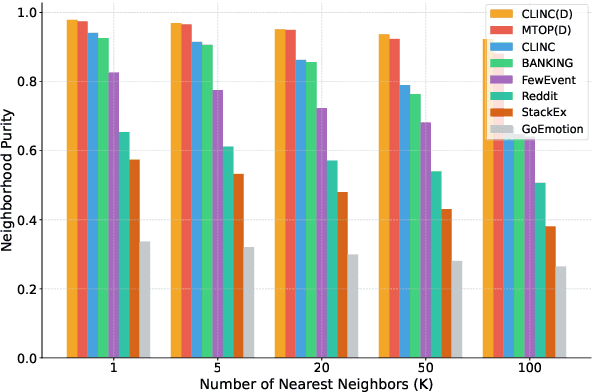
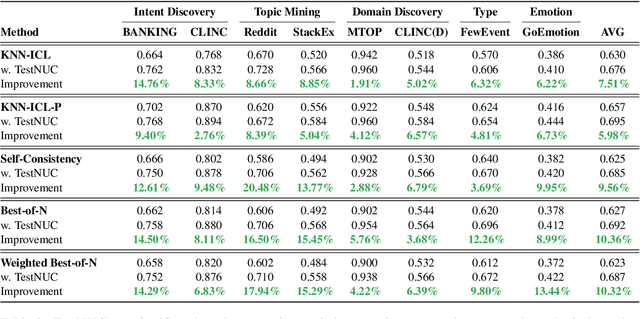
Test-time computing approaches, which leverage additional computational resources during inference, have been proven effective in enhancing large language model performance. This work introduces a novel, linearly scaling approach, TestNUC, that improves test-time predictions by leveraging the local consistency of neighboring unlabeled data-it classifies an input instance by considering not only the model's prediction on that instance but also on neighboring unlabeled instances. We evaluate TestNUC across eight diverse datasets, spanning intent classification, topic mining, domain discovery, and emotion detection, demonstrating its consistent superiority over baseline methods such as standard prompting and self-consistency. Furthermore, TestNUC can be seamlessly integrated with existing test-time computing approaches, substantially boosting their performance. Our analysis reveals that TestNUC scales effectively with increasing amounts of unlabeled data and performs robustly across different embedding models, making it practical for real-world applications. Our code is available at https://github.com/HenryPengZou/TestNUC.